TVO mPower
The Ministry of Education wanted math games. I hired people from Ubisoft, EA, and Capcom, sat them in a room with Ontario teachers, and spent three years finding out what an eleven-year-old will actually play.
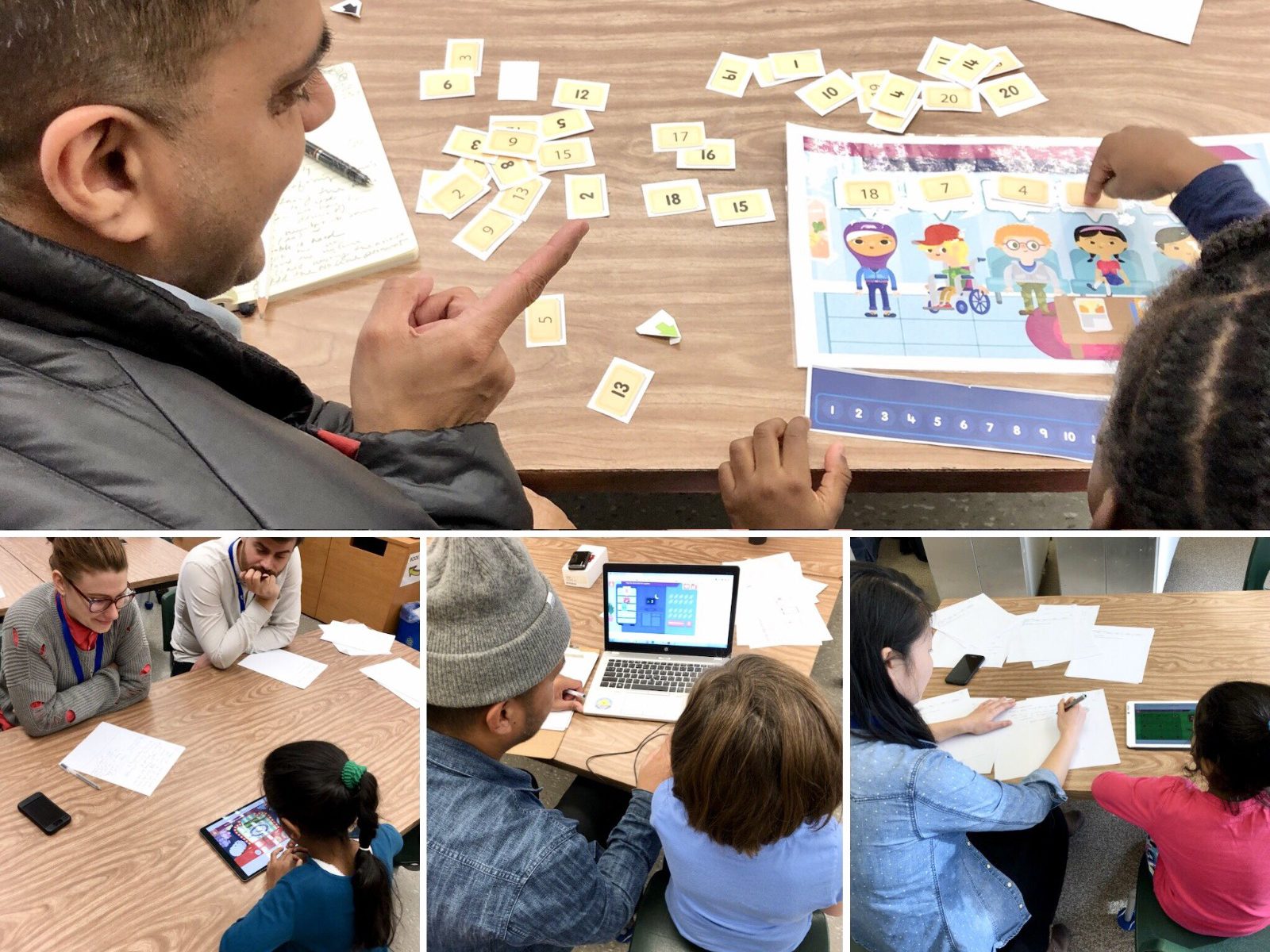
65+ games shipped. Still running. Still growing. 450,000 learners in fiscal 2023, five years after I left.
The finding that reorganized the project
01 · What they playedWe were in schools almost every week, testing with teachers and students. One week we brought a title that was barely more than an idea, and asked the kids what they played at home. Grades 5 and 6: Uncharted, Overwatch, Call of Duty. Grades 3 and 4: whatever the older kids were playing. Not one child named anything remotely educational, and that killed the brief we'd been working from.
It seems obvious now. It wasn't then. We weren't competing with edtech. We were up against whatever an eleven-year-old picks on a rainy Sunday afternoon, and we were going to lose.
So we rebenchmarked against Disney, Lego, Cartoon Network, Nickelodeon and Supercell. K–2 already read as digital activities. Grades 3–6 had to read as an actual game, which meant the two halves of the product would stop looking like each other.
A single consistent design across K–6 would have been a brand win and a product failure.
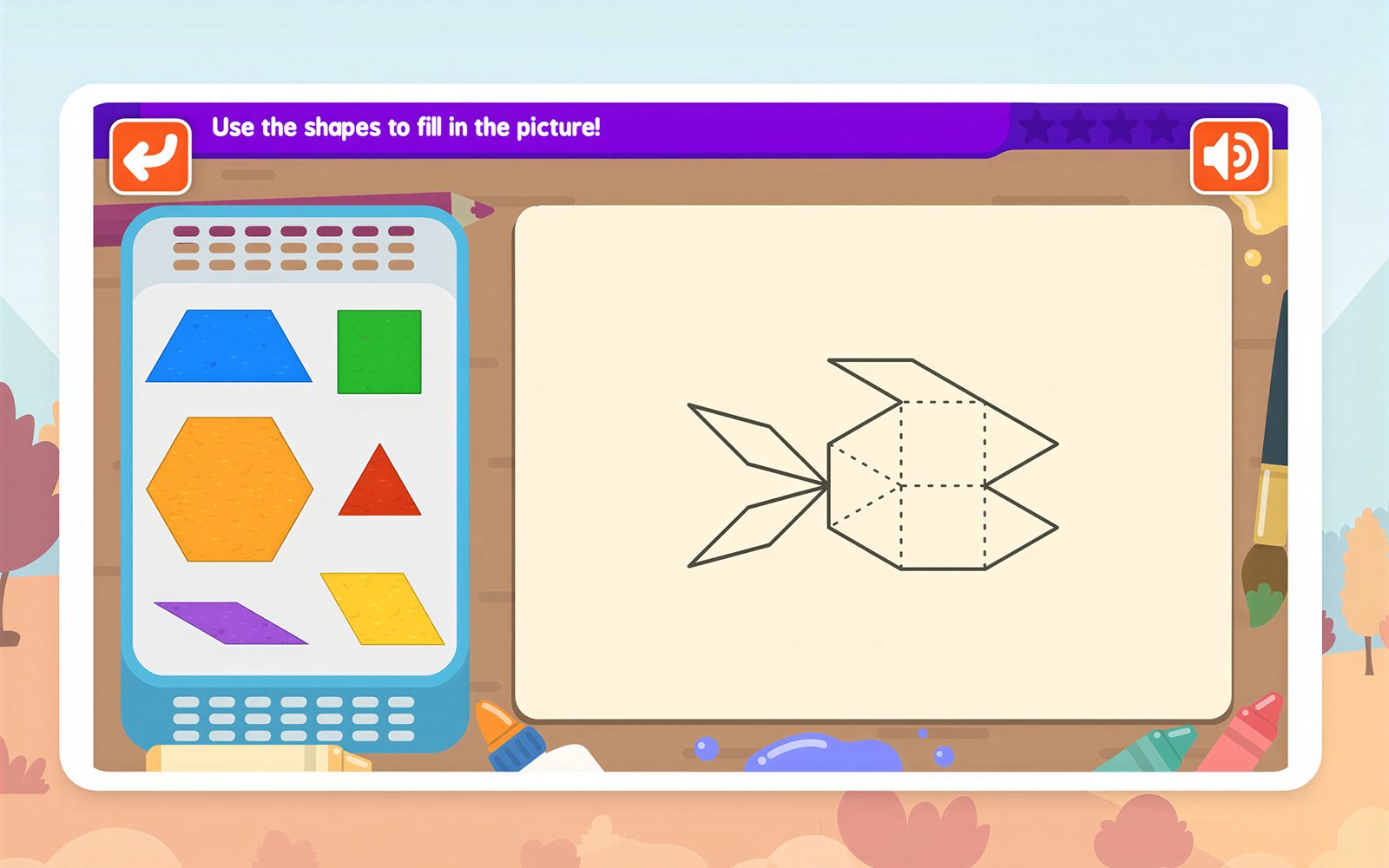
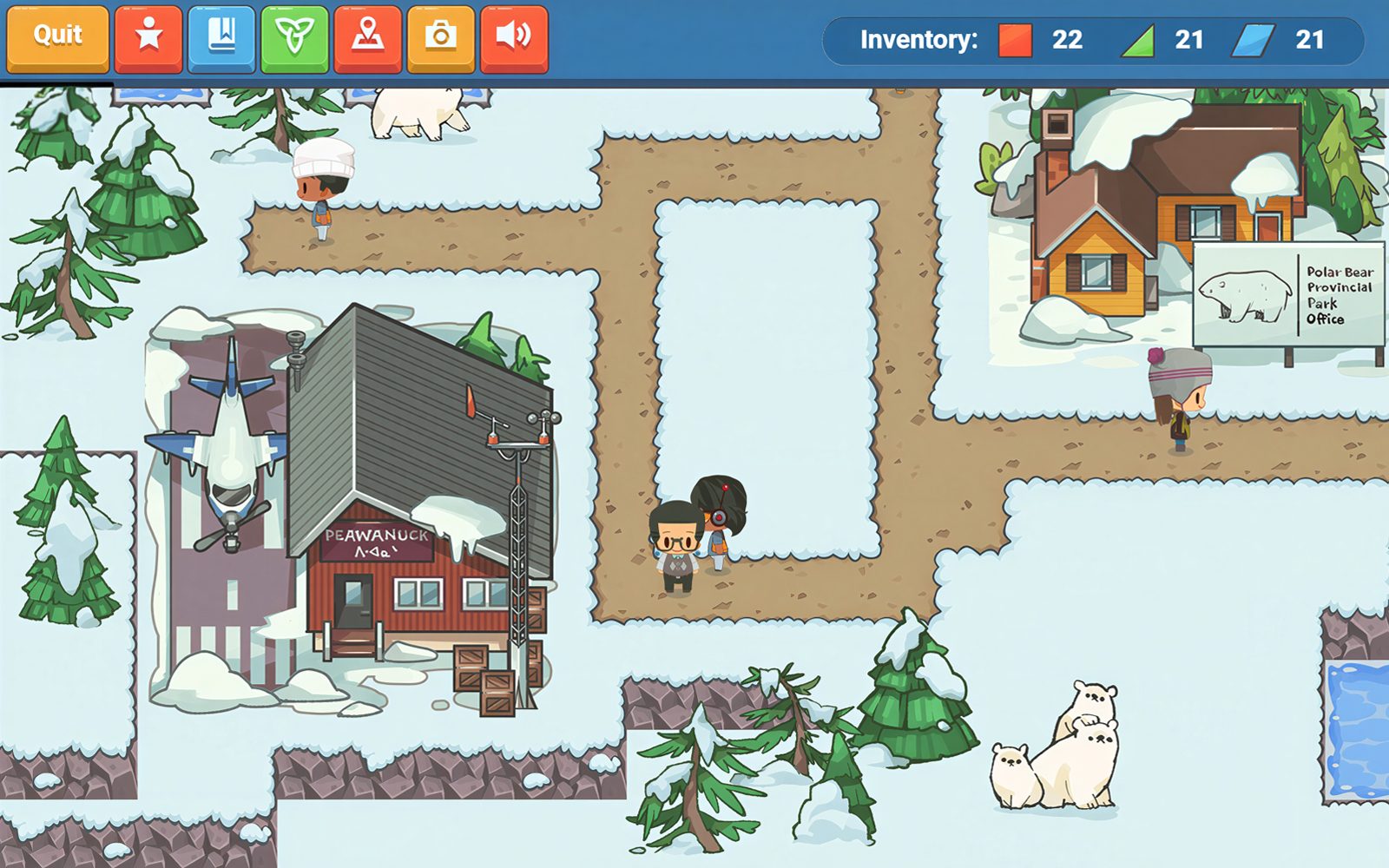
Where it started
02 · The mandateOntario tests every student in math at Grade 3 and Grade 6. Scores were down. Way down. And boys were hit hardest. The Ministry wanted something other than more worksheets, so it put out an RFP.
The pitch came from someone who would later become my colleague: a real video game experience with curriculum built in, mapped exactly to where students were failing. Not "have fun, do math, have fun." The math had to feel native to the play, not a break from it. TVO won.
Then it had to be built. TVO had made Flash games to support its broadcast shows, but nothing curriculum-grade, at scale, as a platform. So it went looking for the capability. I was one of the first hires. The people were there, and many joined my team, but none had made anything like this. There was no pipeline and no precedent, so I built a new team out of TVO staff and people I brought in.
I didn't hire edtech people
03 · HiringIt was a motley crew. Game designers out of Ubisoft and EA. Animators from Capcom. A producer who'd been the games editor for Apple's App Store. Writers from National Geographic Kids and Scholastic. Illustrators from across children's literature.
The first thing I did was sit them in a classroom with a teacher on loan from the Ministry. She didn't walk us through the curriculum, the mandate or the test scores. She taught the lesson, the way a nine-year-old actually learns it. If our games were going to be a digital extension of the classroom, we had to be in that classroom and feel what students struggle with every day. Gamers without the pedagogy make a good game that teaches nothing.
TVO already had talented artists, but their style was built for preschoolers, a long way from Overwatch. Rather than brief them into it, I started a weekly art challenge. It was framed as team building. It was actually a training program in a more mature visual language. It worked, and the challenge still runs today.
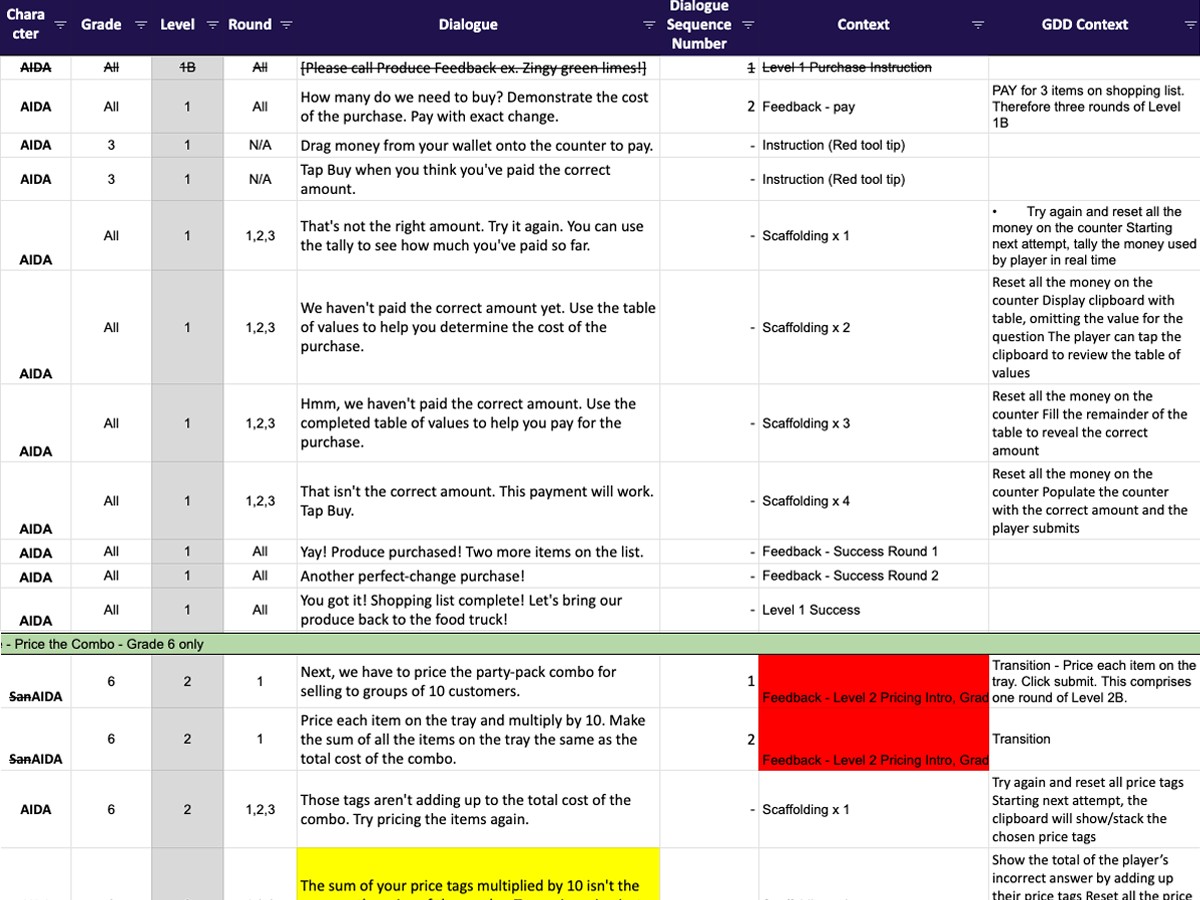
Our writer had taught in a classroom and published children's books as both author and illustrator. Pedagogy and craft were already fused, which is how one writer carried 600+ lines of dialogue, 50 characters and four tiers of scaffolding language across the platform. She wasn't a gamer when she started. She was by the end.
We tested in real schools every week, all year
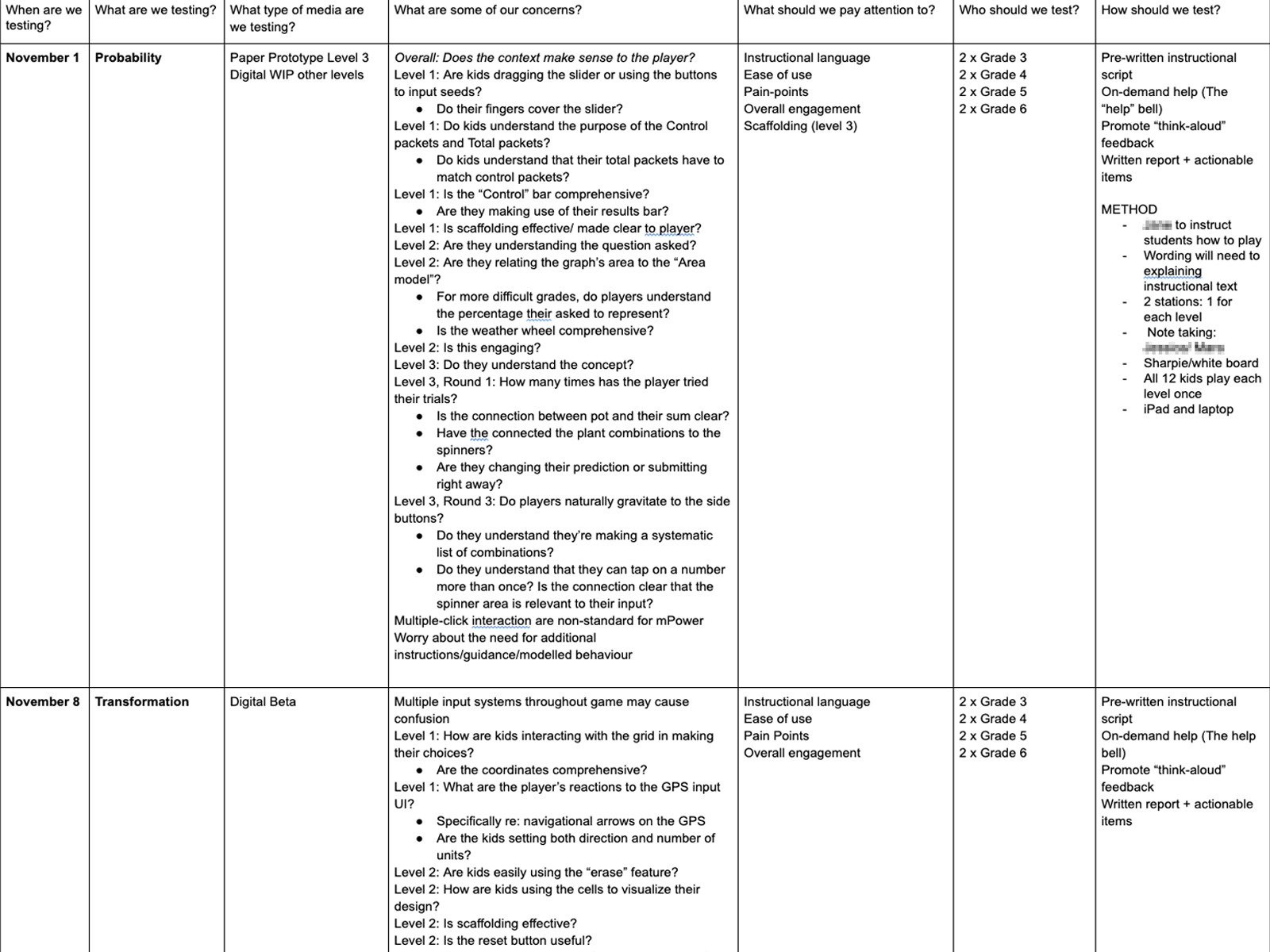
04 · Playtest programmeBefore every playtest we ran the same process. We'd lock in one or two games, write down what was keeping us up at night about them, and flag the likely pain points. Then we let the kids rip them apart. Three things made it work.
Prove it on paper
Each game climbed the same ladder: paper prototype > digital WIP > beta > alpha. We tested scaffolding, gameplay loops and in-game economies at every rung, not just the art. Most problems surfaced on paper, before anyone wrote code.
Testing never stopped
Months after launch and the award, shipped games were still being playtested alongside titles on paper. The K–2 avatar system was tested at zero fidelity while live games ran in classrooms.
Point to the face
For K–2 we used the Wong-Baker pain scale, the chart of smiling-to-crying faces they use at the pediatrician's. Five-year-olds can't tell you how clicking that fish for a clue made them feel, but they can point to it.
"Level 2: Free play. Do they have fun or do they math?"
"Do their fingers cover the slider?"
That protocol is dated months after full launch, months after the award. New titles were still on paper. The K–2 avatar system was still being tested at zero fidelity. Shipped games were being play-tested in production.
The arithmetic stopped working
05 · Pipeline geometryWorking on games like this tapped me into academia for the first time in my career: research papers, PhD theses, anything that could add depth to the games. One study on avatars and low-stakes identity exploration made the case that they build confidence in children. We talked it through as a team and built an avatar system.
Little avatars running around need somewhere to live and play, so we built a world: the province of Ontario, each game a destination, geography and community folded in. A world needs a reason to come back to, so we built a currency. Kids complete math quests, earn shape-based resources and build their own Ontario town. A currency needs rules, so I wrote monetary policy for nine-year-olds. Sinks, caps, earn rates. You can't let kids crash the economy.
Then, halfway through development, the Ministry asked us to add STEM, and we made it the boss level of every game.
All of it was the right design. None of it fit the pipeline.
The moment we committed to the more advanced system was the moment I knew we didn't have the development resources to build it. Nobody had to be unwilling or unprepared for that to fail. The dates didn't work.
Four of us raised it: the product manager, the development manager, the QA manager and me. Nobody was pointing fingers. The question in the room was what do we do now.
Contractors came up and didn't survive the questions. Who manages them? How fast do they ramp?
Going outside
06 · Vendor selectionAn established studio answered both questions: its own experience, process, management and QA. We wrote an RFP.
The serious contender was a studio in southern Ontario TVO had worked with before: good games, local, materially cheaper. They proposed Unity WebGL, which had real promise on a modern machine over broadband.
That was the problem. The mandate was every elementary student in Ontario, which includes boards in remote northern communities running dated hardware on whatever internet infrastructure they actually have, not the one a spec sheet assumes. A build that performs beautifully in Toronto and stalls on the James Bay coast hasn't shipped. We crossed them off on the technology, not the team.
We selected Filament Games. They were the most established of the three, and the only one already making educational games. It carried a real premium, and the premium had to be justified. The development manager is the one who justified it. He attached a talent exchange to the contract: swap developers with Filament for six months, so ours came back with capability we hadn't been able to hire for. That turned short-term contract spend into long-term internal growth, which is what moved stakeholders.
K–2 shipped in-house. Filament built 3–6. Writing, game design, art direction, and voice casting and direction across 50 characters stayed with my team.
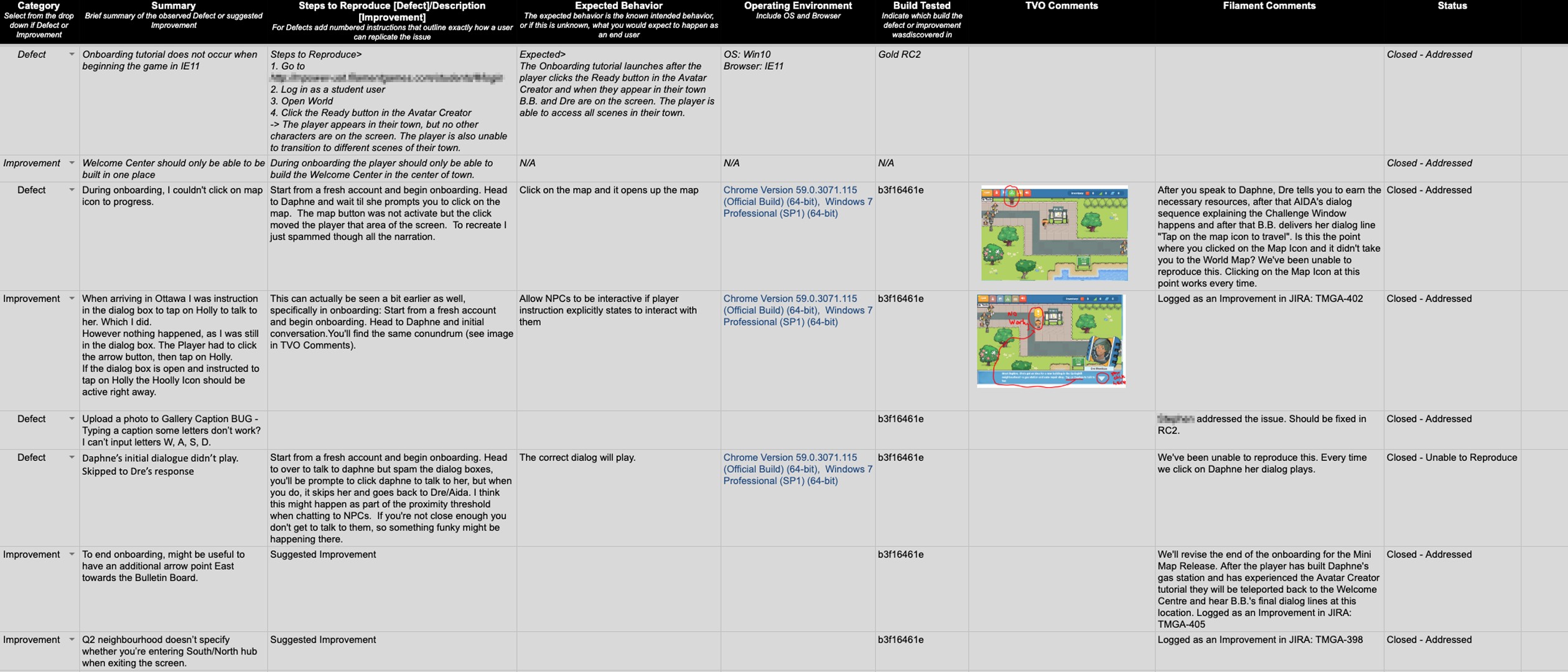
When your developers are twenty feet away you fix things by walking over. Once the build lived in another country I needed an instrument to replace proximity: a shared defect and improvement log with build hashes, operating environments, reproduction steps, and both sides' comments in adjacent columns, plus weekly alignment.
The distinction between defect and improvement did the real work. Defects are obligations, improvements are requests, and that line is what keeps a vendor relationship from turning into a fight.
"Bulletin boards need something to indicate they're active or else more than 50% of content goes undiscovered."
Nothing was broken. The software did exactly what it was built to do. I filed it as a defect anyway, which put a standard into the process: undiscovered content is broken content.
Two systems under the hood
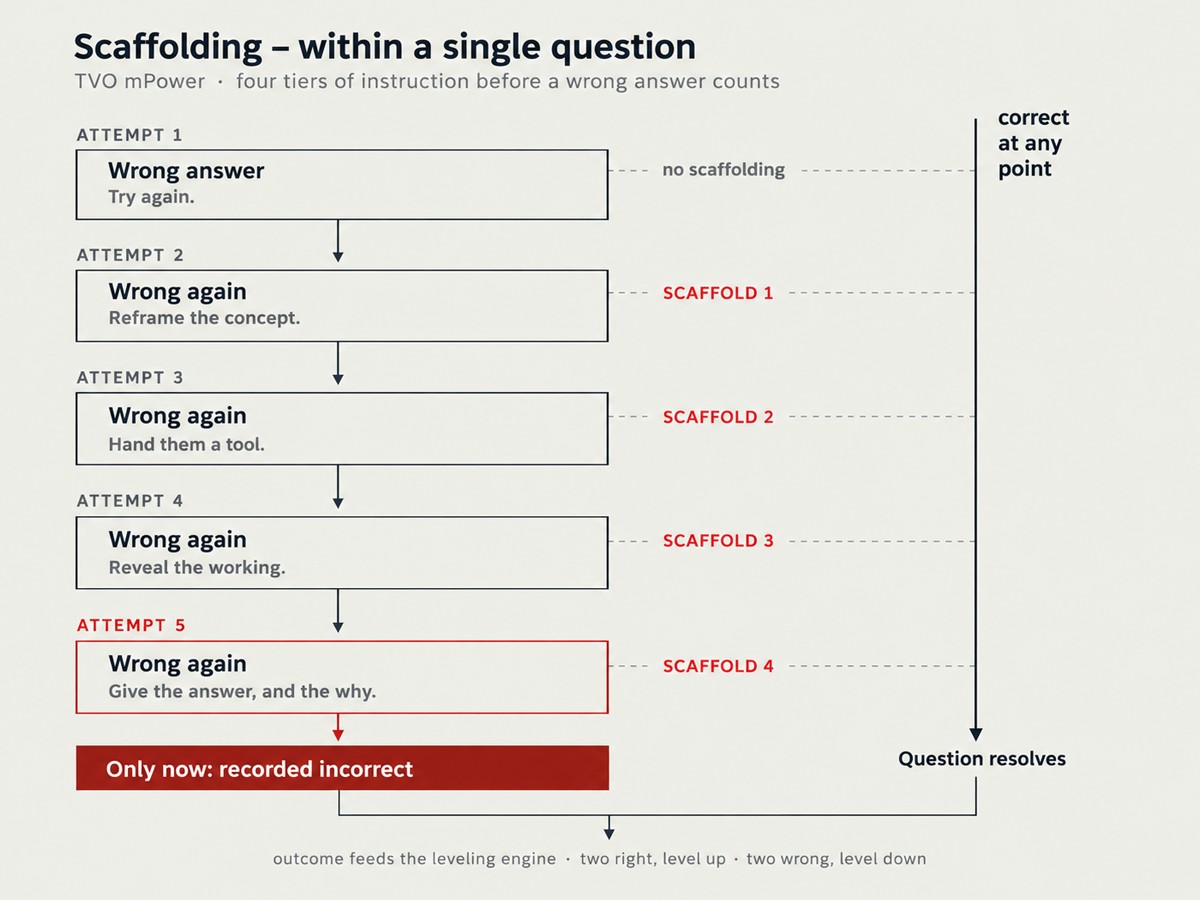
07 · Scaffolding & difficultyScaffolding, within a question. Wrong answer, try again. Wrong again, a conceptual reframe. Wrong again, a manipulative, like number blocks. Wrong again, the answer and the reasoning behind it. Only then does the game record it as incorrect.
Standard educational software marks you wrong on the first miss and moves on. We encoded the opposite position directly into the scoring logic: failure only counts after instruction has been attempted four different ways.
Adaptive difficulty, between questions. Two correct, level up. Two wrong, level down. Persistent across the player's entire lifecycle, so every kid stayed in their own range. The scaffold resolves the question. Its outcome feeds the leveling engine.
This is what the educator workshops were for. You cannot author "think about it like this" four different ways, at every level, across 65 games, unless you know how the concept is taught in a real room.
What it produced
08 · ReachOur VP of Digital Education set an internal target of 2,000 students. We were genuinely worried we'd miss it.
Reach
25,000 students by December 2016. 46,000 K–6 by June 2017. More than 140,000 registered across Ontario. 1.6 million games played in fiscal 2018–19, the year I left.
Recognition
2017 International Serious Play Award, Silver Medalist, judged as games. 65+ titles delivered. Promoted by the Premier of Ontario during COVID school closures, two years after I'd gone.
Every game shipped, a few weeks past the date, which on a build this size is on time. Then the mandate closed. There was nothing left to make, so I left.
In fiscal 2023, five years gone, over 450,000 learners played nearly two million games. Lifetime, mPower has passed ten million. The playbook stayed.